Literature Undergraduate Course Descriptions
Summer Session II 2026 (S226)
LTEA 132 - Later Japanese Literature in Translation
Animals and Modern/Contemporary Japanese Literature
Instructor: Dingding Wang
This course delves into the captivating role of animals as central motifs in modern and contemporary Japanese literature (fiction and poetry) and animation. Students will explore how animals serve as vital historical, material, and symbolic agents shaping cultural narratives and imaginative worlds. Why do certain animals develop charisma while others are despised? How does societal perception of animals transform over time with advances in modern science? In what ways do animals as "secondary nature" or mystical elements in premodern texts evolve in modern literary forms? The course also examines the implications of contemporary hunting, captivity, and domestication. Through analysis of works by renowned authors such as Izumi Kyoka, Natsume Sōseki, Miyazawa Kenji, Kaneko Misuzu, and Tawada Yōko, as well as Studio Ghibli's animation films, students will gain a deeper understanding of the complex relationships between humans and animals in Japanese culture.
- LTEA 132 will count towards the Region (Asia) concentration for the World Literature and Culture major.
LTEN 169 - Topics in Latino/a Literature (d)
Gender & Sexuality in the Borderlands
Instructor: Oscar Garcia
LTEN 169 will be a synchronous remote course.
This course includes a variety of works by Latina/o/x authors to understand how debates of gender and sexuality emerge alongside discussions about the nation, class, and movimiento. Observing the historical breadth of the diverse perspectives, students will gain a critical awareness for discourse of gender and sexuality, as well as a deeper understanding of the issues confronted by this community.
- LTEN 169 will count towards the Region (The Americas) concentration for the World Literature and Culture major.
LTEN 178 - Comparative Ethnic Literature (d)
(Cross-listed with ETHN 168)
IT'S A VIBE: RACE/GENDER/AFFECT
Instructor: Phuong Vuong
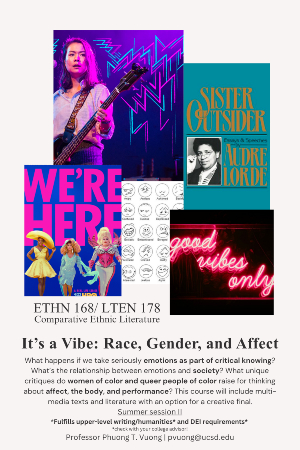 “The personal is political” and the “uses of anger” are phrases that float around on social media and the public sphere when discussing empowerment, especially in relation to women and the queer community. Today, “it’s a vibe” is a phrase you can’t help but hear. Why is there so much discussion about the politics of personal feeling, sensation, or collective senses? What are intersectional feminist and queer ways of conceptualizing feeling or affect? In this course, we will examine these questions through explorations of 19th century and contemporary literary and cultural texts to explore what is opened up through feeling and embodiment. We will discuss the history of feeling as political in the U.S. and consider the possibilities and complications of emotional expression as freedom. We will read, watch, and listen to contemporary poetry, creative essays, music, TV shows, and performances. Queer and trans of color scholars and writers will be highlighted alongside women of color feminist thinkers, including Audre Lorde, José Esteban Muñoz, Kai Cheng Thom, and Ocean Vuong.
LTSP 2A - Intermediate Spanish I
Instructor: Ryan Bessett
LTSP 2A will be an asynchronous remote course.
Emphasizes the development of communication skills, listening comprehension, reading ability, and writing skills. It includes grammar review, compositions, and class discussions. This course is for students who began learning Spanish in a classroom environment. Students who have experience with Spanish outside of the classroom (at home, in their community) should take courses for heritage learners (1F, 2F, 3F, 100F).
LTWL 116 - Adolescent Literature
Sex and Adolescence in American Film
Proposed Instructor: Silpa Mukherjee
LTWL 116 will be a synchronous remote course.
This course will explore the relationship of cinema and youth culture in the United States and assess the role that cinema has played in the multi-discursive field shaping American sexual and political history. We will pay close attention to how understandings of adolescence, gender, and sexuality have shifted over the decades, how teen sexuality is aestheticized, and how representations of gender and sexuality are inflected by other domains of identity, including race, ability, and class.
LTWL 124 - Science Fiction
Futures & Fictions: Technology, Crisis, & Survival
Instructor: Camille Uglow
LTWL 124 will be a synchronous remote course.
What does the future of society look like amid ongoing environmental crises and rapid technological change? What happens when we create things we can no longer control? How can literature help us think critically about these challenges and navigate times of crisis?
These are all questions we will examine in our class sessions through lectures, discussions, and interactive activities. This course explores how science fiction reflects and reshapes our understanding of the world. From climate collapse to artificial intelligence, we’ll examine how writers imagine the future and alternative worlds to question technology, inequality, systems of power, and the limits of humanity. We will engage with a range of multimedia works, including excerpts from Mary Shelley’s Frankenstein, short stories by Ted Chiang, recent bestselling fiction, and contemporary film. We will also work with environmental and science fiction theory, including Rob Nixon’s concept of “slow violence,” which highlights the uneven, global impacts of environmental harm, while considering how different cultural contexts grapple with questions surrounding technology, crisis, and survival. Assignments may include options such as a podcast discussion of course texts or a creative writing project.
LTWR 100W - Short Fiction Workshop
Instructor: Ricardo Novaes de Oliveira
Have you ever wanted to write a short story, a personal essay, or an experimental book that pushes the boundaries of literature? This writing and craft course is for you—expand your interest in writing fiction by engaging with generative writing prompts and eventually giving and receiving feedback from your instructor and peers. Regular writing in the short forms of prose fiction will allow you to experiment with various styles of writing and ultimately bringing your fiction to life.
LTWR 126W - Creative Nonfiction Workshop
Instructor: Oluyemisi Bolonduro
Throughout this course, students will encounter works of creative nonfiction ranging from diary entries to letters to autobiographies to graphic novels and more (read: what you and your peers propose)! Then, we will generate writing prompts inspired by these texts, which may inform in-class freewrites and pieces for weekly workshops. The final will be a Choose Your Own Adventure! (CYOA) that reflects your experience in the course and development as a writer/creative. Lastly, you're encouraged to view this course less as school, grades, hustle, and homework... but more as a writer's retreat focused on rest, memory, learning, and community.
Summer Session II 2026 (S226) Global Seminars
The following Global Seminars are being offered. Students must apply and be accepting into the Global Seminars Program to enroll in these courses.
LTAM 110GS - Latin American Literature in Translation
Proposed Instructor: Bretton Rodriguez
In LTAM 110GS, we examine the development of Latin American Literature from the indigenous societies that pre-dated the arrival of European settlers up to the present day. In doing so, the course provides a broad exploration of the origins of Latin American literature, and it highlights some of the ways that colonization has impacted and shaped Latin American society and culture. Through this course, students will engage with some of the most influential Latin American texts and authors within a larger framework that puts those texts into context and conversation with one another.
Along with the texts that we read, being in Chile will help the students to understand some of the fundamental factors that have shaped the development of Latin American literature. In particular, being able to engage with the city of Santiago and its culture will allow them to see some of the real-world connections between literature, culture, and history. For instance, combining reading Pablo Neruda with visits to his houses in Santiago and Valparaíso will allows students to more fully engage with the individual and the place that shaped his point of view. This is true not only of the Chilean writers, but for all the Latin American authors who we will study.
- LTAM 110GS will count towards the Region (The Americas) concentration for the World Literature and Culture major.